
What a CRM is and what it is for
A CRM is not the tool where the salesperson logs the call. It is the infrastructure that connects the entire revenue cycle, and choosing the platform before understanding that is what makes implementations fail.
A CRM is not for logging calls: it is for managing the asset that keeps the company alive, which is the customer. Every company is born to solve someone’s pain, and everything that comes after comes from the customer. That sounds obvious put this way, and precisely because it is obvious, most operations do not treat the management of that asset as infrastructure. They treat it as software: pick a tool, hand out logins to the team and find out in year three that they bought an architecture decision without ever making the decision.
This text goes with the video above, which is the channel’s entry-level piece. The video is in Portuguese; if you prefer to read, everything is here.
When should a company get a CRM?
At the start there is no customer base. There are two, ten, and a spreadsheet handles it. The problem does not show up in the volume, it shows up in the question.
Past a certain size, someone at the table needs to answer how many leads marketing generated this month, what the conversion from lead to opportunity and from opportunity to customer is, how many contracts close this quarter and which customers have a contract anniversary in November. These are questions about the same asset, seen from different angles, and none of them can be answered in a spreadsheet that three people edit at the same time.
That is the point where a company needs a CRM. Not because it grew, but because it started needing management, predictability and scale at the same time.
| Sales spreadsheet | CRM system | |
|---|---|---|
| Who edits | Several people in the same file, with no idea who changed what | Every record has an owner and a change history |
| Customer history | Disappears when someone deletes the row or leaves the company | Stays on the record: emails, calls, proposals and meetings |
| Stage conversion | Calculated by hand, when someone remembers | Comes straight from the pipeline, by stage and by period |
| Handoff | By message, with whatever context fit in the text | The record moves between teams with everything already collected |
| Revenue forecast | Each salesperson’s opinion, added up | Value weighted by stage and close date |
| Integration | Copy and paste between systems | Forms, email, ERP and ads feed the record |
What does a CRM system do?
CRM stands for Customer Relationship Management. The middle word is the one the market ignores.
To have a relationship, the customer has to exist somewhere before becoming a customer and keep existing afterwards. In a B2B operation the journey usually goes like this: someone subscribes to the newsletter, then downloads a piece of content or is approached on LinkedIn and becomes a lead, gets qualified and becomes an opportunity, receives a proposal, closes and becomes a customer. From there on they become a promoter, who recommends the company, or a detractor, who does not recommend it and sometimes speaks badly of it.
The same record crosses five states and passes through marketing, pre-sales, sales, post-sale and customer success, not counting legal, finance and operations, which come in at specific points. Each team touches the customer with its own actions: organic content, paid traffic and SEO in marketing; pre-qualification and BANT in pre-sales; diagnosis, proposal and negotiation in sales; onboarding, CSAT and NPS after the sale.
Managing the relationship is managing that. It is not knowing whether the person is a lead or a customer, it is knowing where in the journey they are, who is responsible for them at that point and what information the next team will need to receive.
That is why a CRM is infrastructure, not a tool
When I say a CRM is the infrastructure that connects the revenue cycle, I am saying it is made of five things, and technology is only one of them. The other four are people, process, journey and strategy.
The difference is practical. A tool is bought and swapped. Infrastructure defines what the company considers a customer, when an opportunity starts to exist, who is responsible for it and what counts as revenue. Changing that takes months, and nobody replaces an ERP because the screen looks ugly.
That reading is why implementation became an operations project in my consulting work rather than an IT project, within the method I detail in Revenue Operations in practice.
There is no best CRM
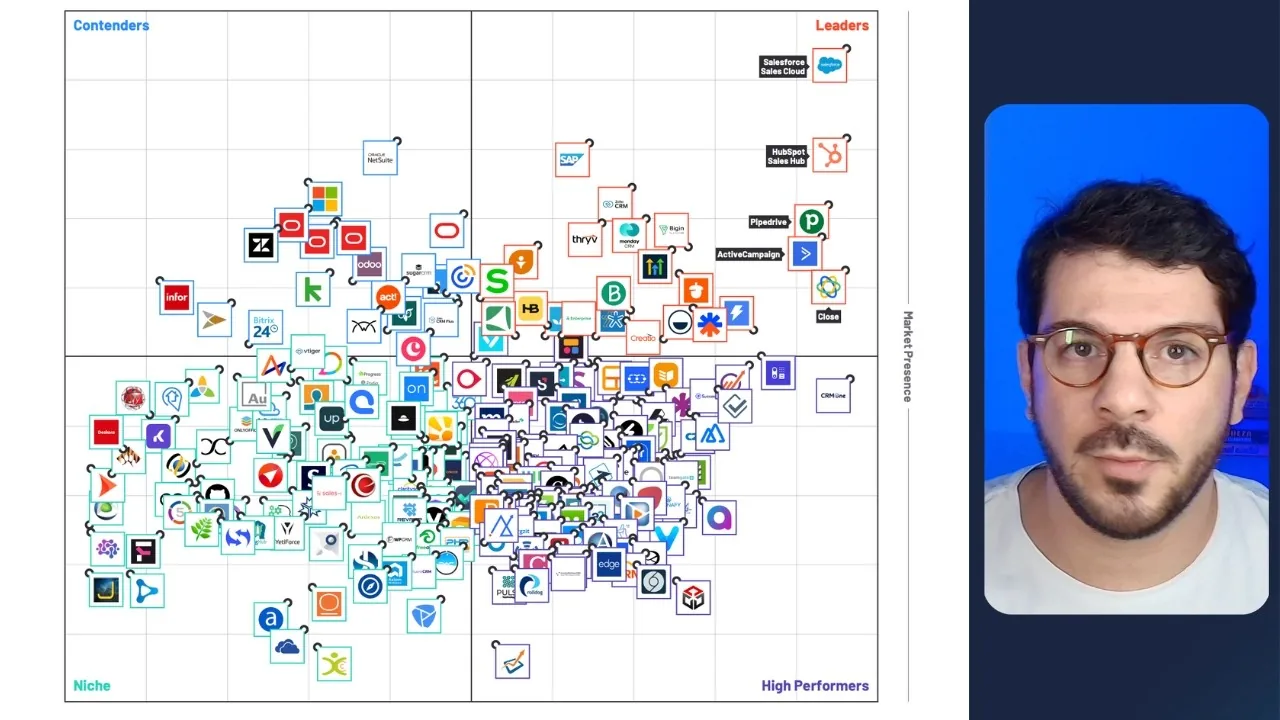
HubSpot, Salesforce, Pipedrive, Microsoft Dynamics, RD Station, Zoho and a few hundred more, which I compare with sources in the best B2B CRMs in 2026. The market has no shortage of options, it has an excess.
The question I get most is which one is the best. It would be irresponsible of me to answer. There is no best CRM, there is your context and your pain, and there is a sentence I repeat in every first meeting: never offer a remedy before you know the customer’s pain.
Whoever picks the platform first ends up designing the process under the constraints of what it already does. The reverse order costs more time at the start and saves years.
The four-question framework
This is the script I use in practice before any conversation about tools. Answer it on paper, in this order.
What is your customer’s journey? When they arrive through a campaign, who handles the first contact. After qualification, who handles the second. What information is needed to build the proposal. What happens between the signed contract and the issued invoice. It does not need to look pretty, it needs logic and sequence.
The tip I always make a point of repeating: however much you think you know, put it on paper. When the drawing appears, it usually becomes clear that you know the business less than you imagined, because the team evolved the process and did not tell anyone.
What information needs to be centralized for good decisions to happen? Make the list by team. What pre-sales needs to qualify. What sales needs to propose. What the contracts team needs at renewal. That list is what will support both the choice and the implementation.
At what point in the journey does each piece of information need to be available, and to whom? Information is transient, and the CRM organizes the type, not the pile. It is worth remembering who collects it: the people on the team, during the conversation with the customer. If collection is not part of the process, the field stays empty and the report becomes indefensible.
Who is responsible for keeping it up to date? This one is about accountability, and it is the one most often left unanswered. The CRM manages the company’s most important asset and, like a heart, it needs to keep moving: inflow, outflow, sales logged, data updated. The month will come when you need a campaign to hit the target, and then the base either responds or it does not.
What to do with this
With the four answers in hand, the tool evaluation gets short and the implementation becomes defensible. Without them, any platform looks right in the demo and falls short in operation.
A note on sequence, because it comes up in almost every project: the framework solves the choice, it does not solve adoption. If the team does not know how to run the conversation that produces the data, the best-configured CRM on the market still has blank fields, which is why training and implementation tend to go together.
If you want a quick test of where your operation stands today, ask three people from different teams to explain when an opportunity leaves the pipeline as lost. If the three answers differ, the problem is not in the software.
If the four questions are already answered and what is missing is choosing the platform, start with the comparison of the best B2B CRMs in 2026. If they still need answering, that is the opening work of CRM implementation consulting.
More writing on the same subject.
The best B2B CRMs in 2026
Eight out of ten Brazilian companies already use a CRM or are implementing one, and most of them still miss their targets. The list matters less than knowing how to read the two sources specialists use.
6 min readRead more
How to make data-driven decisions
A dashboard on the office TV is not a data culture. What sets data-driven companies apart is having the exact number in the meeting where the decision is made, and knowing what to do when it moves.
9 min readRead more
RevOps and CRM in B2B pipeline management
I once rode along with a sales rep who has forty years in the market, a very high income and a paper notebook as his CRM. The pattern behind operations with sustainable revenue is not technology, it is a relationship process.
8 min readRead more