
Data-driven marketing in real estate
A real estate agency does not have one customer, it has two: the owner who lists the property and whoever will live in it. And it has a third audience almost nobody treats as acquisition, which is the broker.
A real estate agency does not have one customer, it has two. The owner who brings the property into the portfolio, because the more owners, the bigger the portfolio. And whoever will buy, rent or use that property. They are two different acquisitions, with different pains and different channels, and most operations only treat the second one as marketing.
This text goes with the conversation above with Rodrigo Werneck, about data strategy in this market, which is in Portuguese.
Behavior changed, and the product followed
The standard lease used to run thirty-six months. Today what opens doors is flexible contracts, no guarantor required and less rigid credit checks, and that is not a legal detail: it is a product change pulled by a change in behavior.
There is a direct competitive consequence. If a large competitor that does not require a guarantor enters your area, the whole market feels it, because the customer is affected right away. You cannot read that move by looking only at your own pipeline.
The third audience: the broker
What stands out most in this market is the distribution channel strategy. The product is the property, and around it there are several paths to the customer.
The digital channel is the one growing fastest and the one everybody discusses. But there is another that is rarely treated as acquisition: recruiting more brokers to sell and rent. It is a data-driven marketing front like any other, and it has a financial advantage that usually goes unnoticed. You do not take on fixed cost, you take on variable cost on top of what that broker produces, and you speed up generation without inflating payroll.
Whoever sees the broker as a channel ends up with three campaigns instead of one.
The three pillars of the strategy
Before any campaign come the premises: where point A is, where point B is, how much you want to grow this year. Without that, strategy is a list of tactics.
With that defined, I analyze three things.
Customer. Audience A, B or D is a demographic cut, and most agencies and builders already have that. The real work is the ideal customer: persona, and exploring the base that already exists. If there is a CRM, a database or even an exported CSV, you can cross it and find out who actually buys. The difference shows up in the campaign: when you know your customer is Jorge, twenty-five, who wants to live near work, lives in the south zone and consumes certain brands, the ad speaks his language and he recognizes the property as being for him.
Market. How the market behaves, what the economic context is and who the competitors are. This is where the guarantor example comes in: a competitor’s move changes your conversion rate without anything having changed in your operation.
Business. How cash generation is going, what the product portfolio is and, the uncomfortable question, whether the product you have today fits what the market is demanding. A lot of marketing strategy tries to solve a portfolio problem with media.
How data comes in, from the simplest to the most advanced
Lookalike audiences, which are the entry point. Take the list of everyone who bought in the last twelve months, or from a specific development, understand the profile and point paid media at people who look like them. It is the media version of what I call generating demand from the base you already have. It is the friendliest model for anyone starting to work with data, and it works on the platforms you already use.
Call tracking, which is what changes the game here. An agency has many phone touchpoints: the broker’s cell phone, the agency’s lines. Instead of forcing the lead to fill out a form on the website, we track straight to the phone, with a specific number per conversion.
With that you know who called which broker, you have the name and the recording. And the side effect is the most valuable one: sales leadership can now listen to whether the broker is using the right language and how long the conversation lasted. It stops being only media attribution and becomes input for management and training. It is the same reasoning as deciding with data instead of guesswork.
It is also the answer to the question every manager has when they increase marketing investment: how to guarantee a return. You can trace the path backwards and know what came from where.
Market intelligence, for the decision before the campaign. If the operation wants to acquire more properties, before choosing the creative you have to choose the area. It is worth using a market data platform to identify potential: the interior of Paraná, the capital of São Paulo, downtown or a specific neighborhood. That strategic direction weighs as much as traffic management, because well-run traffic in the wrong area is still the wrong area.
Response SLA: the real estate lead goes to whoever answers first
People looking for a property request information on several listings in the same evening, on portals and on social media. The agency that answers first books the visit. The one that answers the next day talks to someone who has already visited another property. That is why lead management for developers and agencies starts with a single number: the time between the lead coming in and the first human contact. The target I use is up to five minutes during business hours.
Five minutes are not met with goodwill. They are met with a real estate CRM configured for it:
- Automatic distribution of the lead to the next broker in the rotation or the one for that region, without a manager redistributing by hand.
- An alert on the broker’s phone and automatic reassignment if they do not take it within the deadline.
- An automatic WhatsApp reply outside business hours, confirming receipt and offering visit times.
- First response time measured by broker and by source, on the screen leadership already opens every day.
Added to call tracking, the manager can see who answered, how fast and how the conversation went. The SLA stops being a promise in the manual and becomes a number someone asks about in the Monday meeting.
What to do with this
The sequence I recommend is the same as for any operation: premise, diagnosis of the three pillars, and only then the campaign. Whoever starts with the campaign discovers the product problem with the budget already spent.
If the bottleneck is the design of the operation and the integration between broker, CRM and media, that is consulting. If the data already exists and nobody reads it, that is training. And if you still do not know who buys from you, start there, because it is the cheapest analysis and the one with the highest return, in real estate as in any other market.
A quick test: of the last ten sales in your operation, in how many do you know which channel the customer came through and which broker handled them? If the answer is fewer than seven, your next campaign will be a well-produced guess.
If you run an agency or a developer and want the SLA measured and media connected to the broker inside the CRM, tell me how your operation works today and I will reply with the path that makes sense for it.
More writing on the same subject.
What a CRM is and what it is for
A CRM is not the tool where the salesperson logs the call. It is the infrastructure that connects the entire revenue cycle, and choosing the platform before understanding that is what makes implementations fail.
7 min readRead more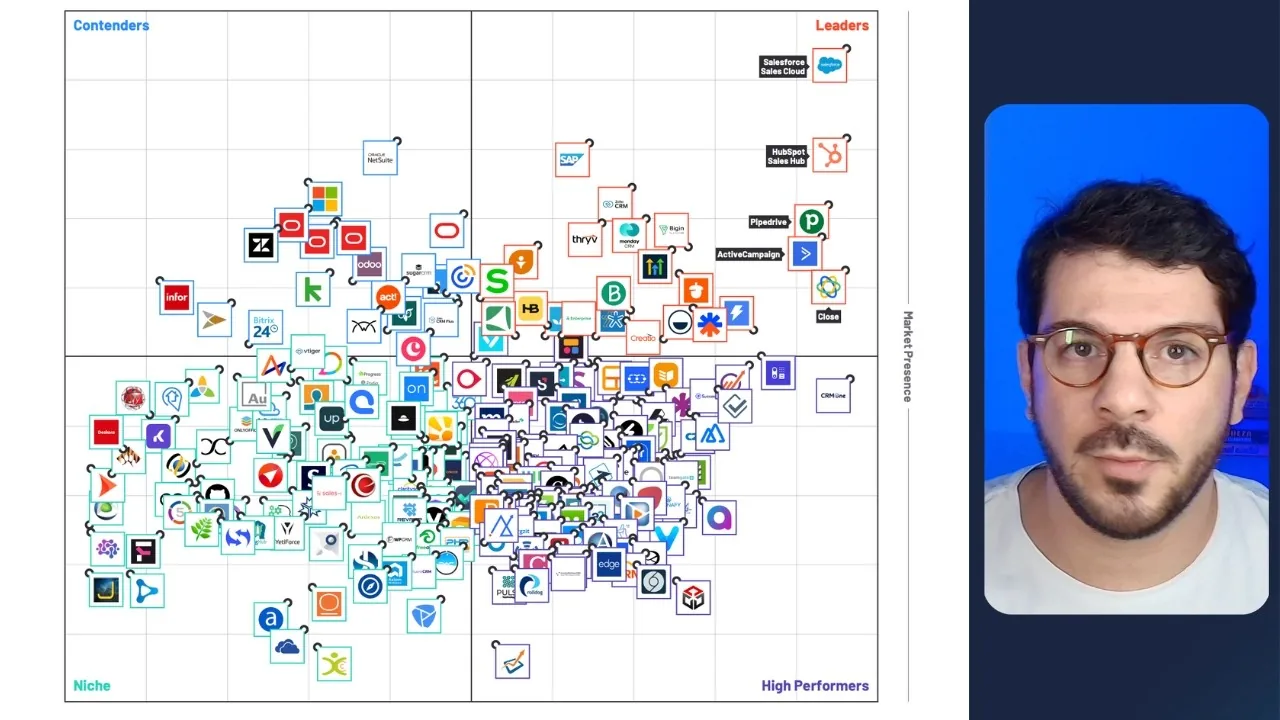
The best B2B CRMs in 2026
Eight out of ten Brazilian companies already use a CRM or are implementing one, and most of them still miss their targets. The list matters less than knowing how to read the two sources specialists use.
6 min readRead more
How to make data-driven decisions
A dashboard on the office TV is not a data culture. What sets data-driven companies apart is having the exact number in the meeting where the decision is made, and knowing what to do when it moves.
9 min readRead more