
How to build competitive advantage in Industry 4.0
Every manufacturer has two sales, to the point of sale and from the point of sale to the consumer, and almost none of them works the second one well. Closing that distance is where the competitive advantage lies.
Every manufacturer has two sales. The first is to the point of sale: the laboratory sells to the pharmacy, the manufacturer sells to the building-supply store. The second is the sale the point of sale makes to the end consumer. Almost no manufacturer works the second one well, and that is exactly where the competitive advantage left in the market lies.
This text recaps the conversation above with Patrick Francisco, on sales intelligence and Industry 4.0, which is in Portuguese. The readings on manufacturing operations came from both sides of the table, and it is worth watching to follow the full reasoning.
The similarities that show up in almost every manufacturer
The segment changes, the product changes, and the diagnosis repeats.
The distance from the end consumer. In the traditional model, the manufacturer knows the pharmacy well and knows little about who buys at the pharmacy. The full sales cycle only closes with the user, and the decision to buy again comes from them. Seeing the whole journey as one thing is what the Revenue Operations methodology organizes.
Indirect channels with little management control. The sales representative is the dominant model and brings a structural difficulty in follow-up. There is a solution, but it is a widespread pain.
Tight cash flow. The manufacturer puts money up front, produces and sells afterwards. A factory is fixed capital by definition.
Stockouts. Sold and could not deliver. Everyone who has worked in industrial sales has lived through this.
A product-oriented culture. Here is the item that explains the others. Manufacturers focus heavily on product development and the first sale, while the market moves toward consumer orientation. It is a change of mindset, and it changes marketing and sales results along with it.
A mature manufacturer is a brand, not a factory
There is a simple maturity test: the end consumer looks at the medicine or the material and recognizes the brand before the product.
When that happens, the manufacturer has stopped being a factory pushing volume into the channel. It has a brand present on social media and fixed in the buyer’s desire. And then the role of marketing changes in nature: it is no longer about promoting the product, it is about building the brand that sustains preference at the point of sale.
It is a hard transition to make because it requires looking at both ends at once, and manufacturing sales structures are usually designed only for the first.
Knowing the customer, which sounds basic and almost nobody does
This is the first step in every project and it is amazing how often it gets skipped.
Brazil spends a fraction of what the United States spends, proportionally, on research. So the recommendation is pragmatic: do research, even if small, enough to bring out a few relevant points about who buys and what drives the purchase.
There is money on the table here, in two ways. The first is influencing the end consumer, which increases sell-through at the point of sale. The second is less obvious: what you learn about the consumer goes back to the product team and improves what will be manufactured. One study serves two teams.
Industry 4.0 in one sentence
If I had to sum up Industry 4.0 in one short sentence: mass customization.
The sneaker that is made for you. The medicine that makes sense for your specific case. And at a viable cost, which is the part that changes everything, because very expensive customization has always existed.
This already happens outside Brazil in some verticals, and here we are still behind the trend. The problem with being behind is the nature of the curve: the technologies that enable mass customization are digital, and digital technology does not advance linearly, it advances exponentially.
The example that illustrates it well is the self-driving car. In 2012, an investor with billions under management would have bet everything that it would not happen within ten years. It happened in seven or eight. If someone with all the information and every incentive to get it right gets that math wrong, prudence does not lie in waiting to see.
For Brazilian manufacturers that have not moved yet, the reading is direct: starting now is not getting ahead, it is catching up.
CRM for manufacturing: direct sales, channels and reps in the same pipeline
The conversation with Patrick touched on the indirect channel as a widespread pain. It is worth going deeper here, because this is where CRM in manufacturing is usually designed wrong.
The same account can be reached by the direct sales team, which handles the large customers, by the distributor and by the sales representative. Without a written rule, two of them quote the same customer at different prices, and the customer quickly learns to play one against the other. The conflict is born from the design, and it is solved with four definitions recorded in the CRM:
- Account ownership by a written criterion, whether territory, segment or size, and not by whoever got there first in someone’s memory.
- Deal registration: whoever registers the deal first gets protection for an agreed period, and the period expires if there is no progress.
- Commission aligned with the rule. If compensation rewards the opposite of what the rule says, the rule does not survive the first conflict.
- Account and rep management in the same system: the rep sees their own accounts, and the manufacturer sees the rep’s pipeline. Without it, the accounts stay in the rep’s head and leave with them.
It is the same principle of RevOps in traditional B2B that applies to any operation: for the customer it is a single journey, however many channels exist on this side.
CRM and ERP integration in manufacturing
The cash and stockout pains that came up above live in the ERP. That is why a manufacturer’s CRM needs to read at least four things from the ERP: available stock with delivery time, the customer’s credit limit, order history and list price by channel. The salesperson who promises a deadline without seeing stock is the one who produces the sale that never gets delivered.
In the other direction, the order won in the CRM has to become an order in the ERP without anyone retyping it. And when the distributor shares sell-out data from the point of sale, it should also reach the CRM, because it is the only signal of the second sale the manufacturer can see before the repurchase falls behind.
Execution, not presentation
A point of method worth recording, because it is where most transformation projects die.
If the diagnosis shows the operation has a gap in opening new customers, because the team works the existing base too much, the way to solve it is not to put together a slide-deck training. It is to get a prospecting campaign up and actually run it, with the team inside it, learning in the process.
Digital transformation is about data, and the data lives in digital. But execution is made of people, culture and process, and that is what changes the operation’s day. Support material helps, it does not replace that. It is the reason hands-on training pays off more than off-the-shelf content, and why consulting does not end at the diagnosis.
What to bring to your next meeting
Ask how much your company knows about who buys the product at the point of sale. Not about the point of sale: about who buys from it.
If the answer comes as a guess, you have found the cheapest gap to close and the one with the highest return, because it improves sales and product at the same time. The same journey-and-data reasoning that applies to sales operations in general, and that I detailed in how to use data to optimize B2B sales, applies here with one extra step at the end of the chain.
If your operation has direct sales, distributors and reps competing for the same accounts, or a CRM that does not talk to the ERP, request a consulting proposal. The first step is to design the channel rules before configuring anything.
More writing on the same subject.
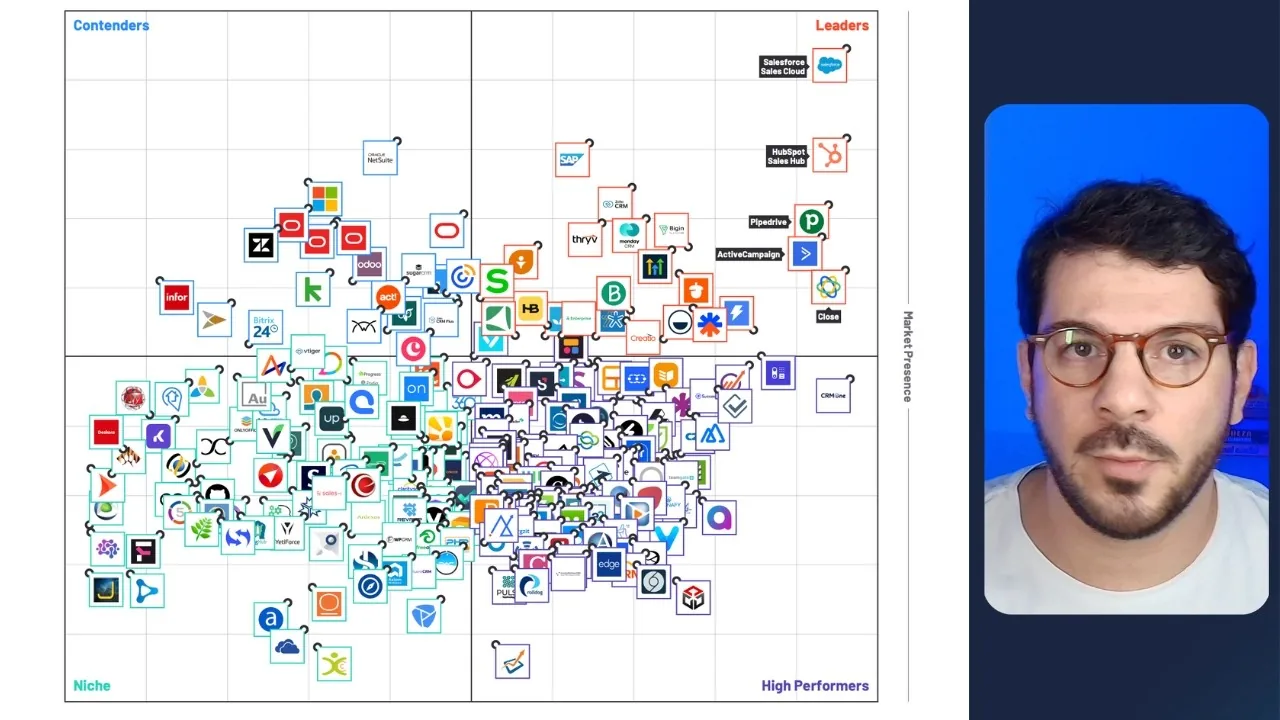
The best B2B CRMs in 2026
Eight out of ten Brazilian companies already use a CRM or are implementing one, and most of them still miss their targets. The list matters less than knowing how to read the two sources specialists use.
6 min readRead more
What a CRM is and what it is for
A CRM is not the tool where the salesperson logs the call. It is the infrastructure that connects the entire revenue cycle, and choosing the platform before understanding that is what makes implementations fail.
7 min readRead more
How to make data-driven decisions
A dashboard on the office TV is not a data culture. What sets data-driven companies apart is having the exact number in the meeting where the decision is made, and knowing what to do when it moves.
9 min readRead more